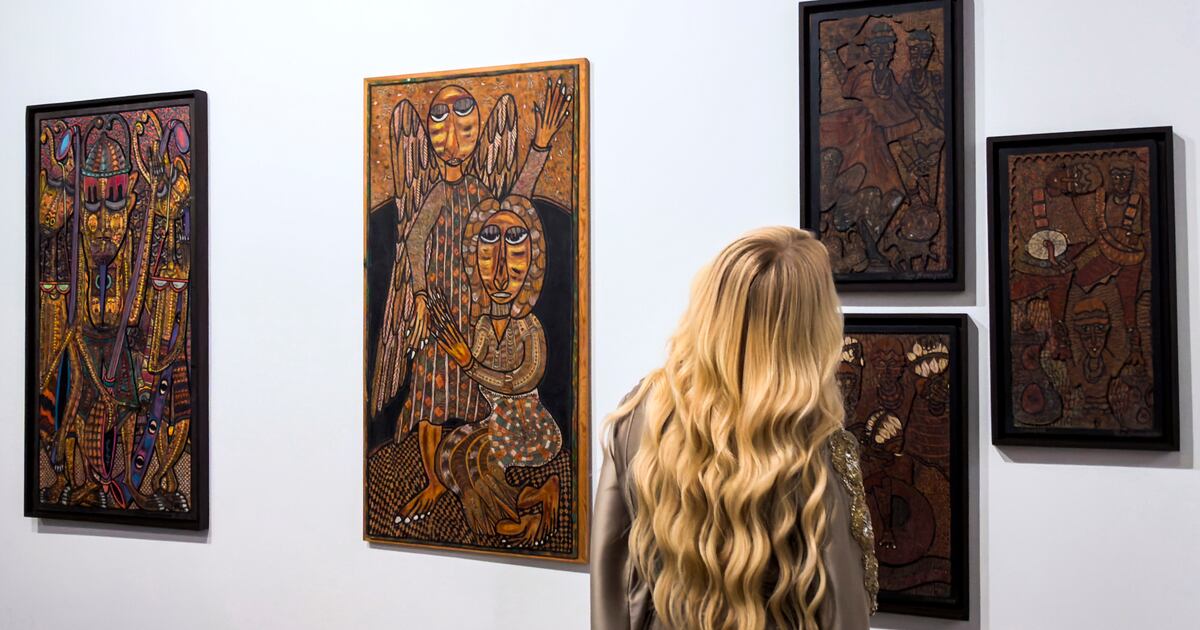
Getting lost at Abu Dhabi Art has always been part of the fair’s charm. Located at Manarat Al Saadiyat in the Saadiyat Cultural District, its maze-like paths branch out with surreal sculptural forms or abstract washes of colour that beckon visitors into their depths.
Go left and you’ll find yourself in another part of the world at another time; go right and you may just be greeted with a warped reflection of yourself.
In its final chapter before transitioning to Frieze Abu Dhabi, this labyrinthine layout is the vastest it has ever been. More than 140 galleries from 37 countries are represented this year, a record for the annual fair. There is a lot to see and to be moved by.
Here, we’ve listed seven artists not-to-miss at the 17th and last Abu Dhabi Art.
Juliana Seraphim
A 1997 painting by Juliana Seraphim showing her femfleur motif. Razmig Bedirian/The National
Juliana Seraphim was a pioneering Palestinian artist whose otherworldly visual language was informed by her experiences of exile. Born in Jaffa, she was displaced to Lebanon in the 1948 Nakba.
As she developed her craft, she worked as a secretary in UNRWA before eventually becoming a global artist, taking part in international biennials and exhibitions. Her work is now housed in collections ranging the Metropolitan Museum of Art in New York and the Barjeel Art Foundation, Sharjah to the Institut du Monda Arabe in Paris.
At Abu Dhabi Art, Gallery One is presenting a mini-retrospective of the artist, in a collection of works that took nearly a decade to amass.
“We are happy to present 30 artworks by her,” George Al Ama, the gallery's co-owner, says. “These go back to the 1960s. We have her famous etchings, ink-on-paper works and the mixed media on cardboard and paper.”
Seraphim’s rich dreamlike world can be perhaps segmented into four topologies. “She focused on the horse, the flower and the female form,” Al Ama says.
In the late 1960s and early 1970s, she began rendering what is perhaps her most known form, the femfleur, a blend of flowers and the female form. Though the femfleur was her fourth and most idiosyncratic theme, Seraphim was also known to work with other motifs, including butterflies and the human eye.
Tala Worrell
Tala Worrell's 2023 work Sub-grade. Victor Besa / The National
Colours, textures and sheens collide with mesmerising verve in Tala Worrell’s canvasses.
Continue Reading on The National UAE
This preview shows approximately 15% of the article. Read the full story on the publisher's website to support quality journalism.