The key is to factor in getting lost instead of worrying about it. Because when you do, you’ll come across the bits that aren’t found in travel guides.
Writing about Fes isn’t easy; where do you begin and end when it comes to a city that dates back to the 9th century with vast literature already available on it — one that isn’t a stranger to tourists or travel guides, and was once considered the epicentre of Islamic civilisation.
Why I’m writing this, however, is simple: to make everyone with an itch to travel to go to Fes — a time capsule functioning as a modern city — at least once.
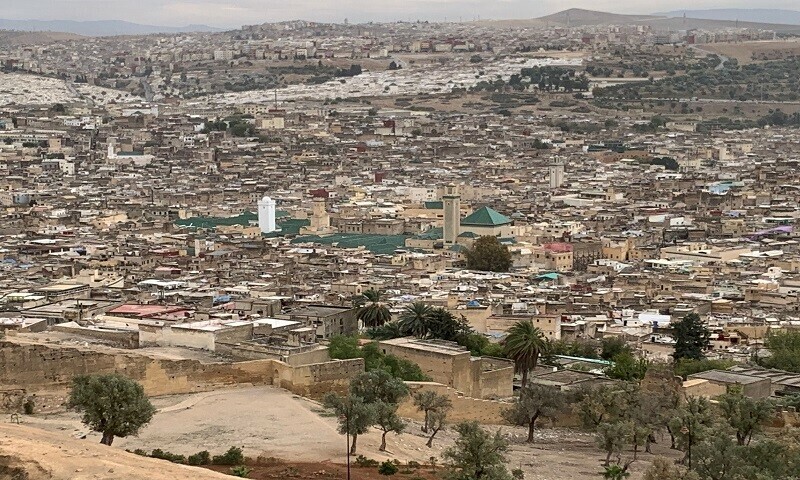
A view of Fes el Bali from the Marinid ruins. — Photo by author
Most travel guides say one to two days are enough for Fes, once referred to as the Athens of Africa and still considered the cultural and spiritual capital of Morocco. I would recommend at least three to four days if your itinerary allows.
Morocco planning 101: Applying for Morocco’s visa from Pakistan is a smooth process (see this link). For currency, Euro is ideal, followed by US dollar and British Pound, and the destination itself is still relatively economical with our plunging rupee as it lets you customise your trip according to your budget when it comes to food, stay and shopping. A bulk of the total is spent on the flight from Pakistan, plus travelling to other cities if you book private cars. With the right planning, trains are an excellent option to get from one city to the other.
Entering the city
Most major airlines fly to Casablanca and for Fes, if you’re as ambitious as us, you can take a car direct from the airport and reach the city in 4-5 hours. Since we were three people, we asked our hotel in Fes to arrange the car — not only is that reliable, especially if you’re travelling late in the night as we were, but you can trust that the driver will know how to navigate through the labyrinths that are the medinas — the old or historical districts of a town or city, typically from the middle ages and typically walled, found in many North African countries.
And navigate he did. Suitcases in toe, we followed him through neon-lit alleys a little before midnight, with the smell of leather heavy in the air and scarce locals giving us a curious look or two. An extremely unassuming entrance led us into our hotel, Dar Seffarine, and even in our exhausted state after 25 hours of travel (two flights, an airport layover and a car ride) we were struck by the grandeur and detailed ornamentation of its architecture.
The high-ceiling central courtyard is an opulent introduction to the complexity of Moorish style: giant cedar doors with geometric patterns, floors with zellij (mosaic tile work), carved columns and horseshoe arches — if I go into any more description, as much as it deserves, the article will become only about this 600-year-old dar (house).
The central courtyard at Dar Seffarine. — Photo by author
Youssef, the young man who checked us in and became our go-to for everything over the next two days, told us it was renovated recently with an aim to keep as much of the true design as possible.
Youssef standing in the Dar Seffarine courtyard. — Photo by author
Three special mentions about Dar Seffarine: the food, made by a young lady Khadijah and her mother, was so good that it ranks as one of the best we had during our entire nine-day vacation; the rooftop terraces with a panoramic view of the old quarters; and a collection of antique djellabas (the D is silent) — a loose-fitting woollen cloak with a baggy hood that has a pointy end and traditional embroidery — that guests could borrow.
Djellabas that guests of the Dar Seffarine could borrow. — Photo by author
The dar is deep inside the famous medina of Fes, a Unesco World Heritage Site since 1981, that is said to contain more than 10,000 historic sites within its walls.
The old quarters are built over a cluster of hills and divided into two parts: Fes el Bali (the oldest section), where we stayed and spent a bulk of our time, and Fes el Jdid (New Fes).
Fes
Continue Reading on Dawn
This preview shows approximately 15% of the article. Read the full story on the publisher's website to support quality journalism.