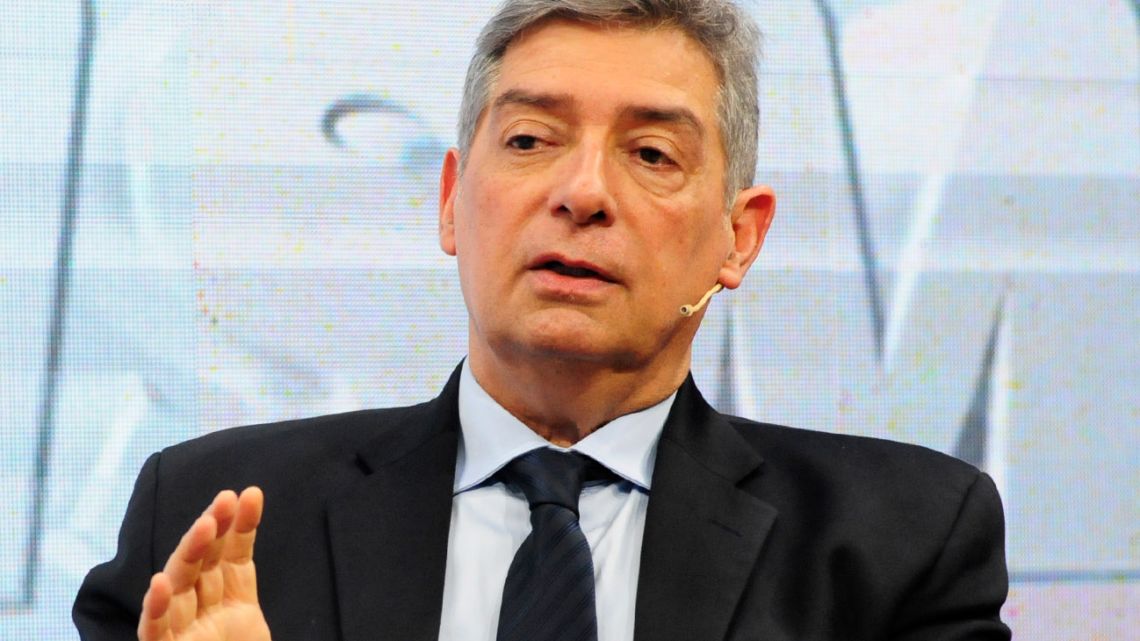
In an extensive conversation with no taboos, Horacio Rosatti, the chief justice of Argentina’s Supreme Court, analyses the most sensitive issues on the judicial agenda: judicial independence, his relationship with presidents, the ruling confirming ex-president Cristina Fernández de Kirchner’s corruption conviction and a lot more.
Rosatti, 69, assures that his links with the heads of state with whom he has co-existed while serving on the Supreme Court – namely Mauricio Macri, Alberto Fernández and Javier Milei – was “practically zero.” None of them called him up “to steer a file,” he explains.
“The only thing I look at is the Constitution and the law,” he states.
In an interview published in El País in Spain, on September 19, 2023, you claimed that if dollarisation eliminates the peso, it is unconstitutional. I would like for you to share with our audience, in layman’s terms, your interpretation of that clash between the Constitution and a potential dollarisation.
A country’s currency has three functions. It’s an exchange instrument. You can pay for goods with it, it’s a reference by means of which we know the value of things. It’s a third party which helps compare the value of a pair of shoes with a kilo of apples. What identifies the value of both, what unifies them is a currency. The third factor is that a currency is a reserve value or can be a reserve value.
So, when we talk about a foreign currency other than Argentina’s, one can understand that it can be a reserve value. If the dollar has historically been a reserve value for Argentines, it’s understandably used as an instrument of payment in certain transactions as well, and that can be regulated – it’s not unconstitutional. The case of the purchase of a property, for instance. What it cannot be is an instrument to determine the value of legal tender.
That is to say, the Argentine Republic cannot issue a currency other than its national one, it cannot issue dollars, it cannot issue [Brazilian] reais. What the Argentine currency can do is to be compared, as has been the case in another stage of Argentine history, for example, parity with another currency, such as the dollar. On the understanding that one can say that the value of the Argentine peso is one in relation to the dollar, but that is not reversible.
I usually give my students an example, which is now old-fashioned: the fact that I like Julia Roberts, I’d say a few years ago and could still say it, perhaps doesn’t mean that Julia Roberts likes me. It’s not a bilateral relationship, and thus we cannot regulate the value of other currencies. And the national currency – defended by the Constitution in Section 75, Subsection 19 of the Constitution – is up to the state, it can only be one’s own currency.
So, we can’t have a single currency that is foreign, because we won’t issue it, we won’t be able to coin it and we can’t set its value, and thus we’ll be constantly checking whether that currency is devalued or not. That’s prohibited by the Constitution.
Following your example of Julia Roberts, we might say that the confusion in the parity in the 1990s was that the peso’s parity to the dollar did not entail the dollar’s parity to the peso. That is, we might aspire to our currency being convertible insofar as we have a sufficient amount of their currency, but not vice versa. We couldn’t ask for dollars to be convertible to pesos.
Correct. And deep down, the underlying thing in this asymmetry is that the value of a country’s currency cannot be divorced from that country’s real economy for very long. That’s why it can be useful, it was very useful during the one-to-one parity, to stabilise the economy but then we should have shifted towards a basket of currencies, we should have diversified because one cannot sustain the value of a currency with a parity to the currency of a country whose economy is sharply different. In that case, much larger, much more prosperous than ours.
Do you think your statement in 2023 somehow influenced the fact that, instead of closing the Central Bank, today’s President [Javier Milei] chose, rather than the dollarisation he had promised when he was a candidate, to strengthen the peso instead?
No.
Continue Reading on Buenos Aires Times
This preview shows approximately 15% of the article. Read the full story on the publisher's website to support quality journalism.