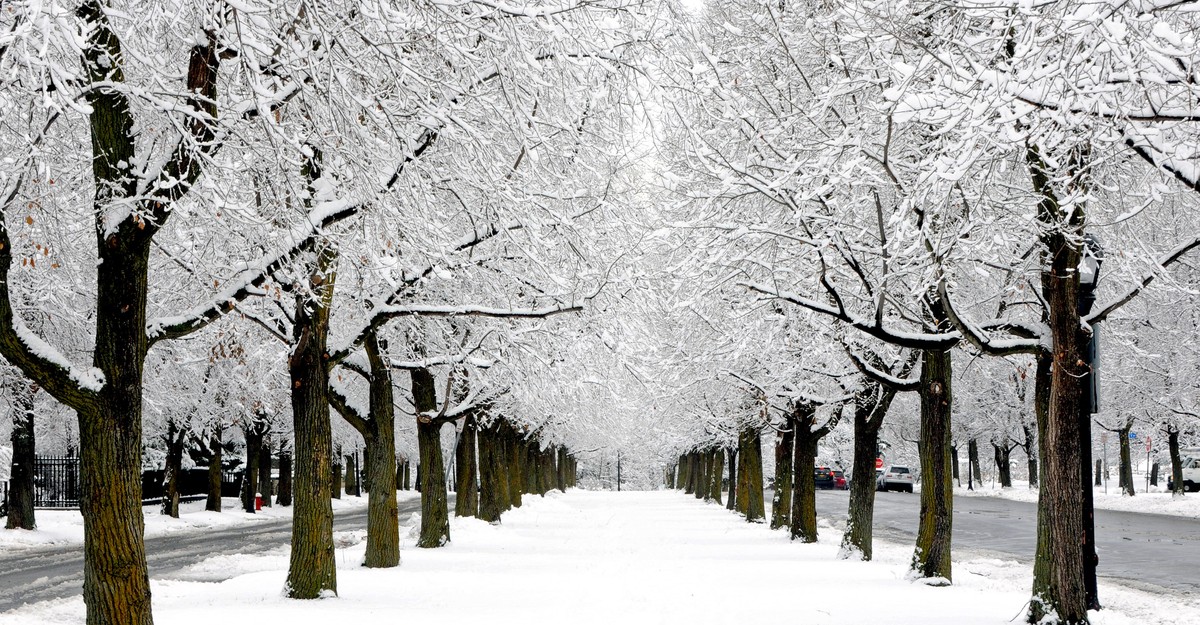
In the language of the Irish, scholars say, there are a dozen words for “peat.” In the language of the Arabs, we’ve been told, there are many words for “sand.” I, for my part, grew up speaking a language in which there are perhaps a hundred terms for snow, and I am not a native of Igloolik.
I learned some of those terms from a man named Mark Williams, a former ski-lodge operator who is a geographer at the University of Colorado and a specialist in the properties of snow. “If you’re talking about snow crystals in the atmosphere,” he told me recently, “well, then, there are scores of terms. There are needles and sheaths and columns. There are pyramids. Cups. Bullets. Plates. Scrolls. Branches. Dendritic crystals. Stellar crystals.” And those are just some of the basic forms. Snow crystals also come in combinations. Stellar crystals with plates. Dendritic crystals with branches. Hollow bullets. Bullets with dendrites. Plates with scrolls. Plates with spatial dendrites. Rimed particles. Rimed needle crystals. Lump graupels. Graupel-like snow with nonrimed extensions. Some of the names of snow crystals (branches, needles, bullets) are appropriately suggestive: in high wind, snow crystals can be as abrasive as sand.
After snow has fallen, the name for it picks up additional qualifiers as it begins to settle or drift, as heat and cold and wind and moisture and the snow’s own weight begin to make their influence felt. Freshly fallen snow starts out as what Williams calls an “ice skeleton”—a loose scaffolding of crystals amid an enormous volume of air. To give his students an idea of the ratio of snow to air in a fresh snowfall, Williams has them compress a family-sized loaf of Wonder Bread to its smallest possible size. (It can be reduced to a two-inch cube.)
In fresh snow air can pass with little obstruction from the atmosphere through the snowpack to the ground: given life by differences in the temperature gradient, the snowpack breathes. But time changes that. The snow may metamorphose into what is called equitemperature, or ET, snow. This is snow at its most stable, the delicate crystals having matured into hardy granules in a snowpack of homogeneous temperature. It may turn into melt-freeze snow, more commonly known as corn snow or spring snow. Where the snowpack meets the warmer ground, there may form a weak and porous stratum of what is known as kinetic snow or sugar snow or depth hoar—by whatever name, the mother of avalanches. If the snow survives for more than a year, it may begin hardening into something called firn, which is a step on the way to becoming glacial ice.
I met Mark Williams and a good many of his colleagues at last year’s meeting of an organization called the Western Snow Conference, a gathering that occurs every spring when the season’s snows are more or less over and the period of snowmelt is well under way. Collectively, the people who attend the Snow Conference meeting—hydrologists, geographers, meteorologists, biologists, chemists, agronomists, utility-company officials, state and federal government officials, representatives of Indian tribes—are known in the gray language of official reports as the “snow-resource community.” They are interested in every aspect of the hydrologic cycle of snow, from the formation of the first crystals to the accumulation of snowpack to the onset of snowmelt to the release of the last drops of runoff into the Pacific Ocean or the Gulf of Mexico. They are interested in avalanche theory, in the seeding of clouds with silver iodide to induce snowstorms, in how to add certain bacteria to water so that ski resorts can make snow at higher temperatures. For decades they have been interested above all in the following questions, which turn out to be complicated ones: How much snow has fallen in the western United States in a particular winter? How much water will it turn into? Where will that water go?
Snow Dependency
Snow is a commodity we usually remember for either the pleasures it offers or the disruptions it causes. We call upon snow, too, for its utility as metaphor: symbol of purity, uniformity, isolation, protection, transience. We tend not to think about snow as the crucial variable upon which urban life and agricultural life in much of the world, particularly the United States—and especially the American West—happen to depend. Indeed, snow is largely missing, as the historian Bernard Mergen observes in a forthcoming study, from recent histories of water policy, in which one would expect it to play a highly visible role. And yet snow, hardened into glaciers, covers 10 percent of the planet’s land area. Fresh snow falls each year on nearly one square mile of dry land out of every four; in the Northern Hemisphere the figure is one square mile out of two. Worldwide, at least a third of all the water used for irrigation comes from snow. In the western United States the figure is about 75 percent.
What makes snow important is not only its volume but also its relative dependability. Much of the West is in a state of drought or near-drought, with snowfall having been below normal in seven of the past eight years. In general, though, snow can be far more reliably counted upon to fall in substantial amounts in the mountains during wintertime than rain can be counted upon to fall in the spring and summertime. And snowmelt flows onto the scene at nearly the most useful time of year, having been stored at high altitudes until the weather warms and the demands of agriculture begin to make themselves felt. It is snow that powers the great rivers of the West—the Colorado, the Rio Grande, the Columbia, the Missouri—on their long journeys through sometimes parched or semi-arid terrain, ribbons of brown and silver that at times enverdure entire basins, at times support the merest Nilotic fringe of green. How much water does the West’s winter snow turn into? The snowmelt that finds its way into the Columbia River alone in an average year comes to 26 trillion gallons, which is 81 million acre-feet—enough to cover all of Kansas in knee-deep water, or to raise Lake Michigan by almost six feet.
The Western Snow Conference typically holds its meetings someplace in sight of the mountains, where in springtime one can have a ready glimpse of snow. I was invited to attend the sixty-second annual conference, in Santa Fe, New Mexico, by a friend who is a hydrologist in California. I’m not sure why the prospect held such appeal, unless it is simply that snow is my favorite kind of weather. The first article I ever published, on a small printing press given to me on a snowy Christmas when I was six or seven, consisted of what was meant to be a report on snow depth in inches, and was distributed to neighbors.
Continue Reading on The Atlantic
This preview shows approximately 15% of the article. Read the full story on the publisher's website to support quality journalism.