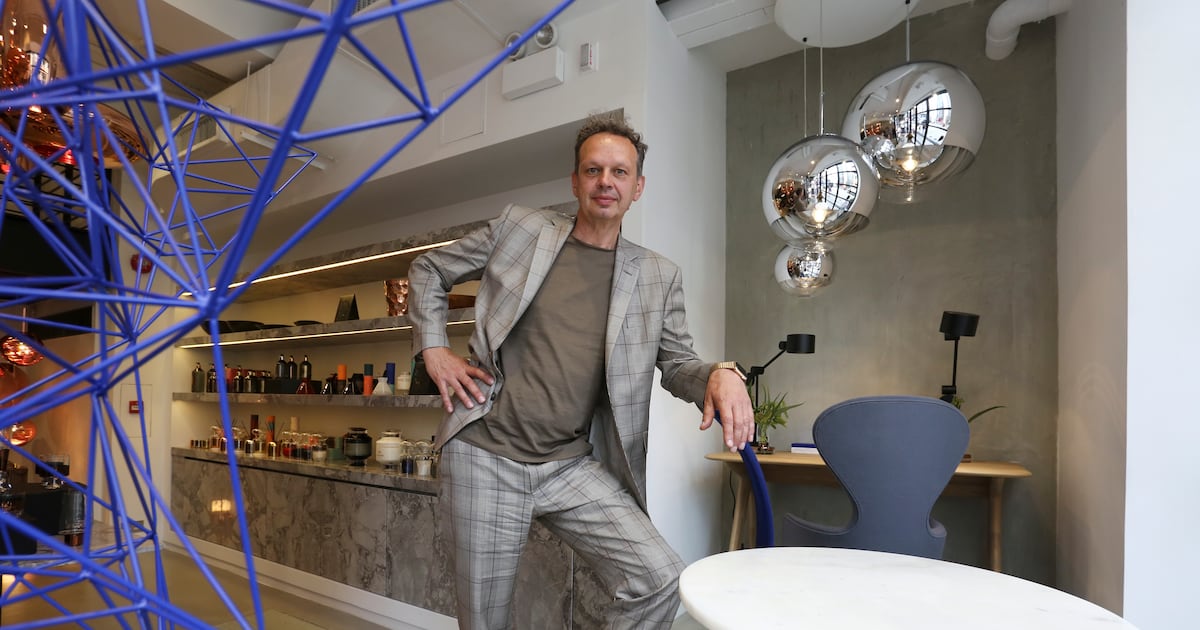
“I was born in Tunisia,” British furniture designer Tom Dixon tells me when we meet. “I lived in Rabat and Suez. Obviously that’s not here,” he says gesturing around to the general space at Dubai Design Week last month. “But culturally, linguistically and religiously, there are similarities. I’ve not really spent any time here, so it’s nice to discover it.”
In town to speak at an event, Dixon is not your average designer. Entirely self-taught, he has spent more than four decades producing a fearless and eclectic body of work, from industrial-style furniture to hotel interiors. Curious, restless and averse to formality, he has launched a design laboratory (“Space”); served as creative director of popular UK furniture store Habitat; opened The Manzoni – a Milanese restaurant designed down to the last detail – and established his own brand in 2002, followed by his architecture and interiors studio in 2007.
Contemporary kitchen, Habitat 67, Montreal, designed by Moshe Safdie showing Beat Fat Pendant by Tom Dixon. Getty Images
In 2000, Dixon received an OBE royal honour for his services to design from Queen Elizabeth II. Today, his studio spans cities such as London, Milan, Hong Kong, New York, Tokyo, Shanghai and Hangzhou, and his work sits in the permanent collections of major museums.
The path looks linear, he says, but it wasn’t. Though many online profiles list him as a graduate of Chelsea Art School, he laughs at the idea. “I tried art school for about six months because I didn’t know what else to do. Then I had a motorbike accident, broke my leg and never went back.”
Part of London’s underground music scene in the early 1980s, Dixon became the bass player in disco outfit Funkapolitan. “For two years, I was a professional bass player. Then I had another motorbike accident and broke my arm.” Dropped from the band, he watched a “much better player” take his place and later perform with Madonna, Michael Jackson and Pink Floyd. “That could have been my destiny if I hadn’t had an accident, right?”
Dixon started off by 'making things for fun'. Getty Images
Instead, he channelled his energy into making furniture, welding salvage metal into new forms. Initially only “making things for fun”, he began selling pieces to friends. “It grew organically very quickly. I never went back to music.”
By 1987, he had created the Fish Pan chair – assembled from welded pots, pans and ladles – followed by collaboratio
Continue Reading on The National UAE
This preview shows approximately 15% of the article. Read the full story on the publisher's website to support quality journalism.