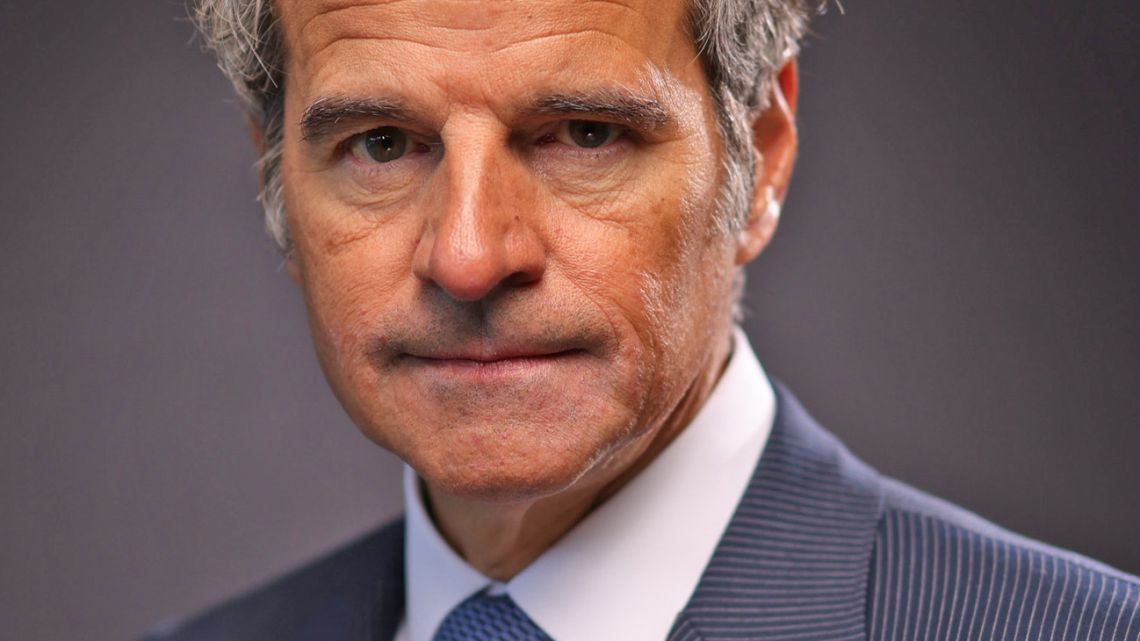
Rafael Mariano Grossi is a career diplomat whose professional life, in recent years, has been defined by his work on nuclear non-proliferation, disarmament and international security, placing him at the forefront of geopolitical tensions.
Grossi, 64, joined Argentina’s foreign service in the 1980s and held a series of senior posts in the diplomatic corps before moving into multilateralism, taking on key posts in Vienna and The Hague.
He served as chief-of-staff at the OPCW, the Organisation for the Prohibition of Chemical Weapons, and held senior roles at the International Atomic Energy Agency (IAEA), the UN’s nuclear watchdog. In 2013, he was appointed Argentina’s ambassador to Austria, also becoming its representative to the IAEA and other UN organisations.
In December 2019 Grossi entered the frontline of multilateralism, when he was elected as the sixth director general of the IAEA. He is the first Latin American to hold that position and was re-appointed for a second term in 2023.
Grossi has since been at the centre of some of the most complex diplomatic disputes involving nuclear safety and compliance. Hhe has won plaudits for his energetic, front-footed approach to diplomacy that has seen him meet key actors in global disputes (including Vladimir Putin, Volodymyr Zelenskyy and top authorities in Tehran), visit Iranian facilities to inspect nuclear facilities and cross into active conflict zones in the Ukraine war, during which he has seen himself come under gunfire. He has also been actively threatened by leaders in Iran, who have promised to “deal” with Grossi when the time is right.
Grossi’s service, experience and energetic approach to diplomacy has seen him installed as a leading contender to replace UN Secretary-General António Guterres, when the current UN chief’s term in office ends in December 2026.
In an exclusive interview with the Times, conducted in the days days after his candidacy was officially launched by Argentina’s CARI think tank in Buenos Aires and prior to US President Donald Trump’s ouster of Venezuela’s Nicolás Maduro, Grossi discusses the United Nations, his approach to diplomacy and his career to date.
I enjoyed seeing you speak at CARI. The first thing that I wanted to ask about is this phrase you returned to: “Active diplomacy.”
Yes...
The UN has this reputation, or it has had historically, about having leaders that take their time, whereas your approach seems to be a bit more energetic.
I would say active diplomacy because it’s what, in my opinion, it’s badly needed at the moment. And I think you have to think about your approach to what is happening.
Of course, you have to think, you have to avoid being rash and things like this. This is the golden rule of everything, in particular diplomacy, and not to be hectic, not to be impromptu.
Continue Reading on Buenos Aires Times
This preview shows approximately 15% of the article. Read the full story on the publisher's website to support quality journalism.