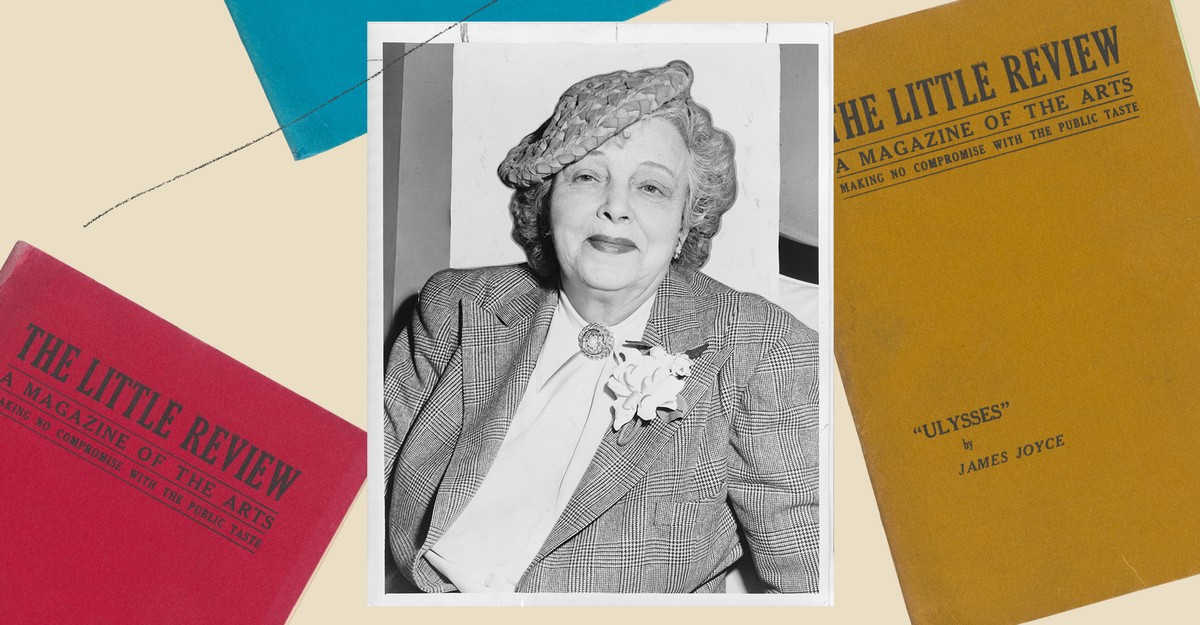
Many editors languish in the margins of history, their contributions largely invisible despite how much they shape whom and how we read. But in recent years, amid a wave of books unearthing overlooked figures, biographers have turned their sights to pioneering book and magazine editors—including Malcolm Cowley of Viking, Judith Jones of Knopf, Bennett Cerf of Random House, and Katharine S. White of The New Yorker—anointing them as the unsung architects of the American literary canon. These biographies tend to illuminate not only the editors’ work, but their lives, challenging the stereotype that they were mere pencil pushers.
Perhaps it was only a matter of time before the trend came for Margaret C. Anderson, whose avant-garde, Chicago-based literary magazine, The Little Review, introduced American readers to such modernist heavyweights as Ezra Pound, T. S. Eliot, and James Joyce. Adam Morgan’s impassioned, finely researched new book, A Danger to the Minds of Young Girls, isn’t the first account of Anderson’s life and work—that would be Making No Compromise, Holly A. Baggett’s dual biography of Anderson and her co-editor and romantic partner, Jane Heap. But this is the first to focus entirely on Anderson, who founded The Little Review in 1914. Morgan, also the founding editor of a Chicago-based literary magazine, convincingly argues that Anderson more or less single-handedly transformed the Review “from a Chicago curio” into a transat
Continue Reading on The Atlantic
This preview shows approximately 15% of the article. Read the full story on the publisher's website to support quality journalism.