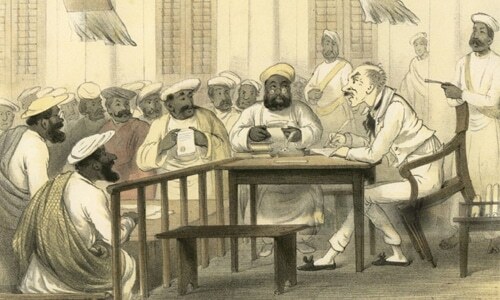
An illustration titled The Judge from the book Curry and Rice. Published in 1860, the book was written by George F. Atkinson after his travels across India | Sarmaya Collection
INTRODUCTION
Dr Rashid Jahan (1905-1952), a prominent Indian literary figure, was an early 20th century writer and social activist. She was an active member of the Progressive Writers’ Movement, a communist and is often considered one of the first feminists in the Subcontinent. Her writings, titled ‘Dilli Ki Sair’ [A Trip to Delhi] and ‘Parday Ke Peechhay’ [Behind the Curtain], published in the seminal anthology Angaaray [Embers, 1932], caused a major uproar among the public.
Despite this, Jahan continued to write plays and short stories alongside other activities that included political activism and her career as a gynaecologist. Over the course of her short life, she taught at the Lucknow Nursing College and, later, established a nursing home for women in Lucknow. Her contributions as one of the few educated Muslim women were remarkable, especially considering her short lifespan. She died at the young age of 47.
Originally written in Urdu, the following short story titled ‘Mujrim Kaun?’ [Who is the Criminal?] was published posthumously in the anthology Shola-i-Jawalla, a collection of Jahan’s works edited by Dr Hameeda Saeeduz Zafar. Set during British colonial rule in India, the story explores the theme of justice through a parallel narrative, one that highlights the ironic disparity in how law and justice functioned for colonisers versus the colonised.
WHO IS THE CRIMINAL?
It is evening and the British Club is crowded today. The road is lined with cars as far as the eye can see. Blue tennis curtains fastened tightly to the wall are trying to conceal the club’s day-to-day operations from the filthy and unclean Hindustani eyes. Nevertheless, the Hindustanis occasionally catch a glimpse of a mem sahiba, or a sahib, or some Hindustani officer.
A hockey ground stretches out before the club and it is already crowded with our Hindustani brothers. They move in slow, deliberate steps, but they are all facing the club.
The early 20th century Urdu writer Dr Rashid Jahan’s works were often at the centre of public fury due to their unapologetically confrontational nature. Her skill as a writer is captured in her short story ‘Mujrim Kaun?’ [Who is the Criminal?] — a poignantly tragic tale that offers powerful commentary and insight into the inequality and contradictions of the colonial legal system. Eos presents its first-ever English translation…
Who knows why they’ve gathered? Perhaps the high walls, the drawn curtains, the very secrecy of the place and the constant flow of cars have sparked a longing, a search, as if they have gathered to wait for a spectacle.
“Yaar, that’s the officer from the electricity department.”
“And whose wife, the white lady, is he holding in his arms?”
Laughter breaks out.
“You people are quite something. What if she is just some white lady?”
“If you aspire to be a gentleman like that, perhaps you might introduce us to your wife, our sister-in-law, rather than keeping her out of the way. We’d be honoured to make her acquaintance.”
“We have heard that she is blind in one eye and is also flat-nosed.”
Everyone begins to laugh.
“Look, who are those, the dark ones?
Continue Reading on Dawn
This preview shows approximately 15% of the article. Read the full story on the publisher's website to support quality journalism.