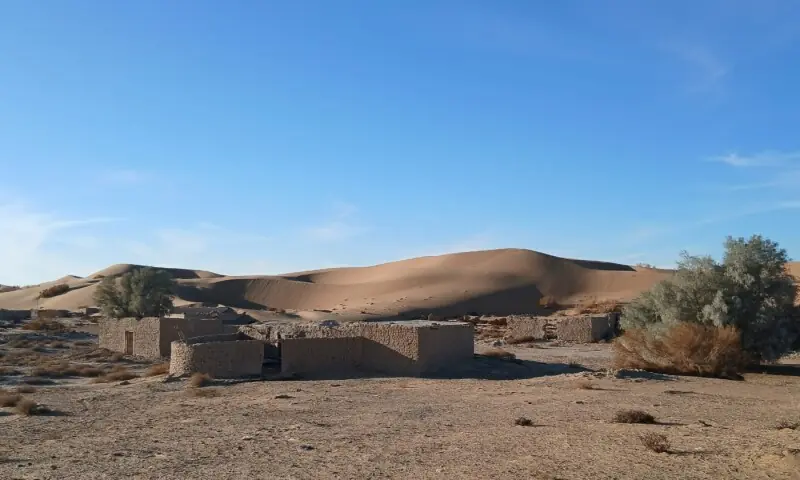
Drought has left the district’s villages shrinking and its homes abandoned; the once-populated Daak area is now entirely deserted.
Ramazan Mengal looks older than his age, even though he has applied henna on his beard and moustache to dye the grey strands of hair.
He is a local villager and shepherd from Sangeen, a remote settlement in an abandoned cluster of villages called Daak, located along the Pakistan-Iran border in Balochistan’s Nushki district.
To an outsider, it might appear as if he leads a very simple life, but in reality, Ramazan is saddled with debt, one which he hasn’t been able to repay for years. He says that instead of shrinking, the borrowing has continued to grow. He tells Dawn that his debts are tightly bound to the drought that has defined life in his village for decades.
A man walks past desiccated desert scrub on a drought-stricken plain in the Daak area of Balochistan’s Nushki, which has been affected by repeated spells of drought since 1997. — Akbar Notezai
The old shepherd’s livestock began to weaken as the grazing land dried up and the grass started to vanish. Many animals died due to the extreme shortage of food and water. With no pasture left, he was forced to purchase the animals’ fodder at prices far beyond his means.
Ramazan’s creditor, a trader in the main bazaar of Nushki town, lends money to many villagers. Like most families in Sangeen, Ramazan survives on borrowed money. Due to the frequency of borrowing, he cannot recall the exact amount he owes.
“I think I have to pay Rs300,000 or Rs400,000 to the trader,” he says, sitting i
Continue Reading on Dawn
This preview shows approximately 15% of the article. Read the full story on the publisher's website to support quality journalism.