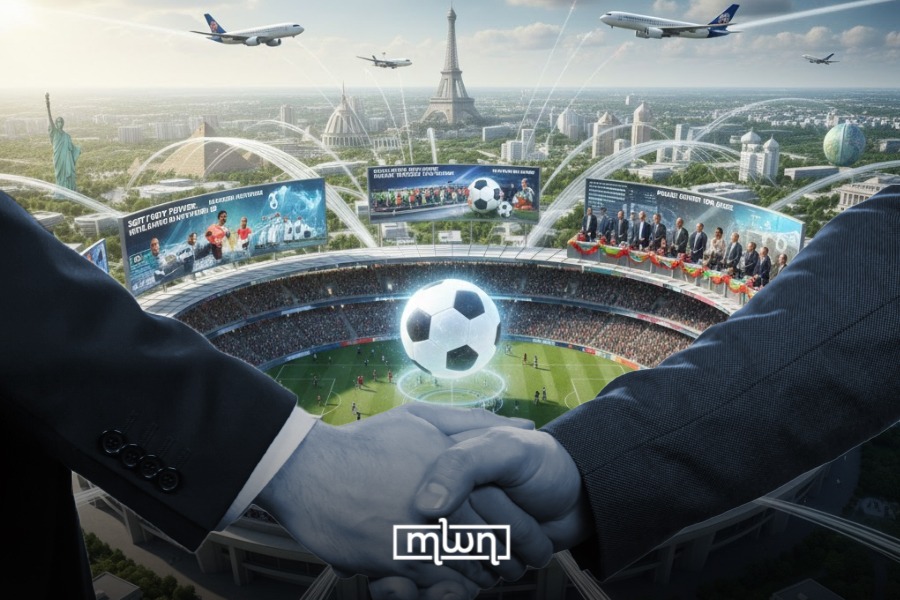
The African Cup of Nations (AFCON 2025), December 21st, 2025 to January 18th, 2026, and the FIFA World Cup in 2030 constitute two landmark events in the governance of global sport and especially for the Kingdom of Morocco. The country has not hosted the African tournament since 1988. And co-hosting the World Cup with Spain and Portugal, which will symbolically link to South America, will represent the first genuinely transcontinental World Cup.
Through the organization of these mega-events, Morocco shows an engagement that should be understood as a strategic convergence signal of sport diplomacy, regional cooperation, and economic policy, embedded within its diplomacy and broader national interests.
Rather than presenting the two tournaments as stand-alone sporting events, Morocco approaches them as a long-term political, economic, and diplomatic investment.
The analysis of Morocco’s strategy actually draws on three complementary theoretical perspectives. First, the soft power theory helps explain how states use culture and symbolic capital to enhance international influence. In this case, football, which is a globally shared cultural language, offers Morocco a powerful platform for attraction, visibility, and legitimacy.
Second, regionalism and new regional cooperation theories emphasize flexible, functional, and issue-based partnerships among neighboring countries. The Morocco–Spain–Portugal hosting model reflects a form of pragmatic regionalism that transcends formal institutional boundaries between Africa and Europe.
Third, the political economy of sport highlights how mega-events are embedded in global capitalism, involving state intervention, private actors, global media markets, and uneven economic and social impact. Through the AFCON 2025 and the World Cup 2030, football is therefore both a diplomatic instrument and a market-driven industry.
Global impact of football
Unlike hard power (military or economic power), soft power is based on attractiveness, through the use of music that seduces, of a film that fascinates, some political values that inspire, or a diplomacy that reassures. It is such attractiveness that shapes the global perception of a country.
History is replete with examples where states used soft influence as a tool of diplomacy for the crucial role it can play in promoting development, strengthening foreign relations, or projecting their image and power. One of the most notable examples remains the “ping-pong diplomacy” episode between the United States and China in 1971. A simple encounter between table tennis players, an American and a Chinese, paved the way for a historic diplomatic rapprochement between their two countries after so many years, marking a possible return of China on the international stage.
More than ever, football has evolved in our time far beyond a sporting activity, to become a major economic sector, a diplomatic instrument, and a source of soft power for states. Its global influence is such that football governing bodies, clubs, and even individuals can rival governments in wealth and political weight, as symbolized by the FIFA President, M. Gianni Infantino, who is actually treated at the level of a head of state. Moreover, players are sold and bought in a market, while superstars are evaluated at hundreds of million euros.
Moreover, to be convinced of the capitalistic aspect of football as a global industry, one has just to see how some European clubs are followed and watched in large parts of the world and how huge are the revenues generated by the broadcasting rights and sponsoring.
Some countries have tried and managed to impose their respective image and culture on the world through cinema production, media, universities, and so on. But other countries, such as Qatar, appear to have wisely exploited their resources too by means of influential news channels, global sporting events (such as hosting the FIFA World Cup 2022), and strategic investments abroad, including European football clubs and stadiums.
However, soft power is not without its critics. Its effectiveness depends on consistency between words and actions. A nation that promotes human rights internationally but violates them at home loses credibility in the end. It is also vulnerable to disinformation, manipulation, or competition from other powers.
In a multipolar and changing world order, the new so-called “smart power” has emerged as a strategy that balances hard power, economic strength, and influence diplomacy. It is seen as a response to contemporary challenges.
Football as a tool of strategy
For a few decades now, hosting major football tournaments has generated significant ec
Continue Reading on Morocco World News
This preview shows approximately 15% of the article. Read the full story on the publisher's website to support quality journalism.