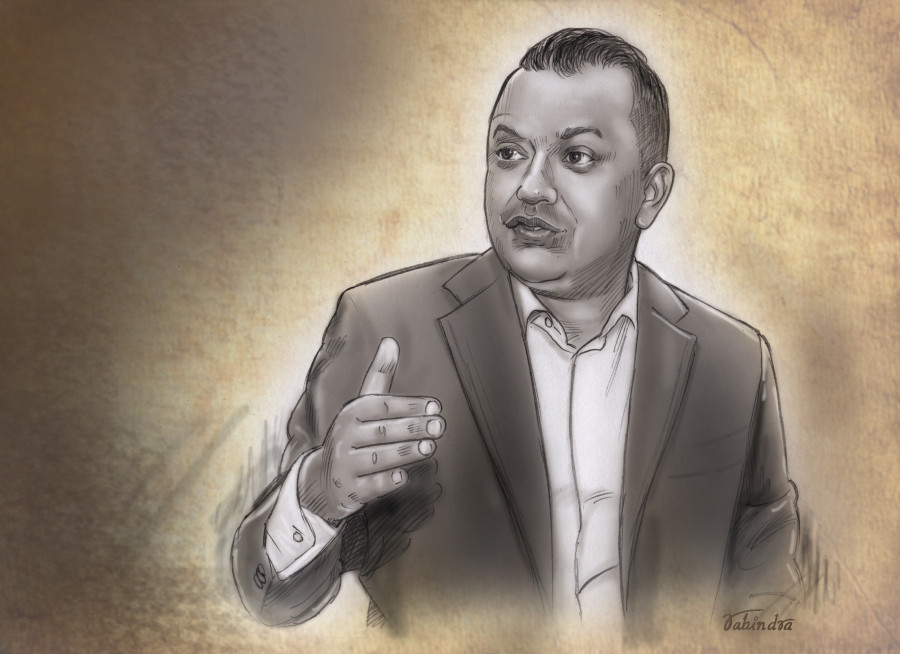
Two days after the mob burned his house down, Gagan Thapa sat in a friend’s living room and did something most other politicians don’t have the courage to do. He turned on his phone, looked into the camera, and said sorry.
It was September 11, 2025. Kathmandu was still smouldering. The army had taken over the streets. Government buildings, police stations, and the homes of political leaders bore a post-apocalyptic look – smoke still rising from the beams of Singha Durbar, the air over the already polluted valley too hazardous to breathe. Prime Minister KP Sharma Oli had resigned. Young Nepalis took to Discord servers to debate whether to dissolve the constitution entirely. A truce, hastily brokered by the army, was taking shape to appoint a caretaker prime minister.
Thapa was visibly shaken. His hands trembled. “I apologise for the deaths of the 19 individuals who were killed on September 8,” he said, “although I was not directly involved in this.”
In an interview with the Post earlier this month, he said he felt like his job was to bring everyone together instead of taking sides. “We needed to open channels of conversation, with all humility,” he said.
Thapa’s decision to post the apology video was calibrated, but it also felt genuine. That combination is what has defined Thapa’s three-decade career in Nepali politics. He is a man who understood, earlier than almost anyone in the Nepali Congress, that the monarchy had to go. He pushed for republicanism when his own party president called him a royalist for it. He spent time in detention on sedition charges and came out more popular. He aimed to reform the health ministry in ways his predecessors hadn’t and then waited, patiently, for the moment when the party would finally be his.
Gagan Thapa's apology video, posted on September 11, 2025.
That moment, it turns out, required a violent revolt.
Now, a week before the March 5 elections, 49-year-old Thapa leads the Nepali Congress into its most consequential vote in a generation — a party he wrested from its old guard in the chaos following the September uprising, in what his critics call an opportunistic gambit and his supporters call a democratic reckoning. He is contesting from Sarlahi-4, deep in the Madhes, pitching himself as simultaneously the newest politician in Nepal — as well as the most experienced. He is the establishment candidate running against the establishment.
Standing in his way, among others, is Balendra Shah — the former Kathmandu mayor turned prime ministerial candidate who has spent the past month touring the country as the leader of the Rastriya Swatantra Party (RSP). Where Thapa’s entire career has been an argument for why institutions matter, Shah’s has been a pitch for why they don’t. Whether voters believe Thapa may determine not just who leads Nepal's oldest party, but what kind of country Nepal becomes.
Listen to this story 0:00 / 0:00
* * *
The moment that forced Thapa to post the video last September was not his first crisis.
Continue Reading on Kathmandu Post
This preview shows approximately 15% of the article. Read the full story on the publisher's website to support quality journalism.