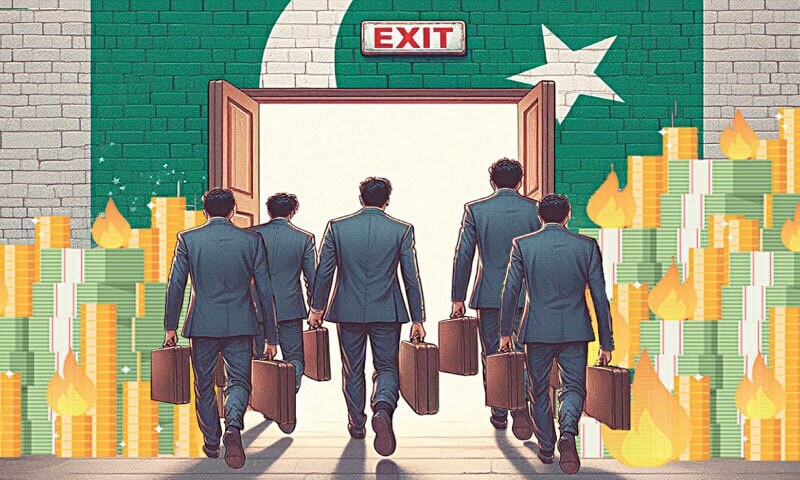
Is this the global economic environment at play or does this reflect deep fractures in the country’s economic and regulatory framework?
There have been a flurry of announcements over the last few years by various multinational corporations (MNCs), either exiting Pakistan or significantly scaling down their operations here. Some of the prominent ones include Procter & Gamble, Shell, Caltex and Eli Lily, among others.
There has also been a significant slowdown in manufacturing activity, where more than half of products tracked by the Pakistan Bureau of Statistics through the Large Scale Manufacturing index have exhibited a median drop in production of 10 percent annually, over the last two years.
The gradual exodus of MNCs from Pakistan is a multifaceted affair that cannot be viewed through a mundane political lens. It is a mix of evolving strategies at a global or regional level for the respective entity, as well as a lacklustre economic and investment environment locally.
This write-up explores how the business models of MNCs have evolved over the years and how a shift in global trade is catalysing the exodus. There is also some introspection about how consistently elevated sovereign risk, and one of the more regressive taxation regimes in the world, has pushed any kind of formal business over the edge in Pakistan.
Even as the government touts policies to attract foreign investment, a number of multinational giants have been scaling back or exiting from Pakistan in recent times. What is going on here? Is this the global economic environment at play or does this reflect deep fractures in the country’s economic and regulatory framework? And can anything be done about it?
HISTORIC CONTEXT
Many MNCs that exist in developing markets were birthed by parent entities operating in those areas, mostly to serve the interests of colonial powers, or to consolidate the same.
As the sun started to set on colonialism after World War II, the emperor got new clothes, the MNC in this case, and they all got a makeover, trying to shy away from a troubled history. It can be an MNC that sold soaps and was notorious for operating palm plantations through bonded labour in Central Africa, or an MNC that basically led the Nazi war machine but now sells innocuous chemicals.
The history of MNCs has been dramatic and they have evolved with time. Only recently, after 355 years in operations, did the Hudson’s Bay Company shut down, after laying the foundations of Canada through trading fur across the Atlantic and eventually morphing into its largest landowner — only to be succeeded by a chain of department stores that were killed by e-commerce. They could survive multiple wars and the death of the Empire, but could not survive the post-pandemic transition to e-commerce shopping.
During the late 2000s, there was a similar mass exodus of financial institutions, not just from Pakistan but from other developing markets as well. This was largely due to higher compliance costs and the realisation that the only way to give economic returns to shareholders was to scale up and become one of the top five institutions in the respective country. It is only through scale that one can extract economic returns; without scale, they struggle and keep losing market share.
Many of these institutions survived the Opium Wars in China, and others, only to be forced to scale down by activist shareholders.
Continue Reading on Dawn
This preview shows approximately 15% of the article. Read the full story on the publisher's website to support quality journalism.