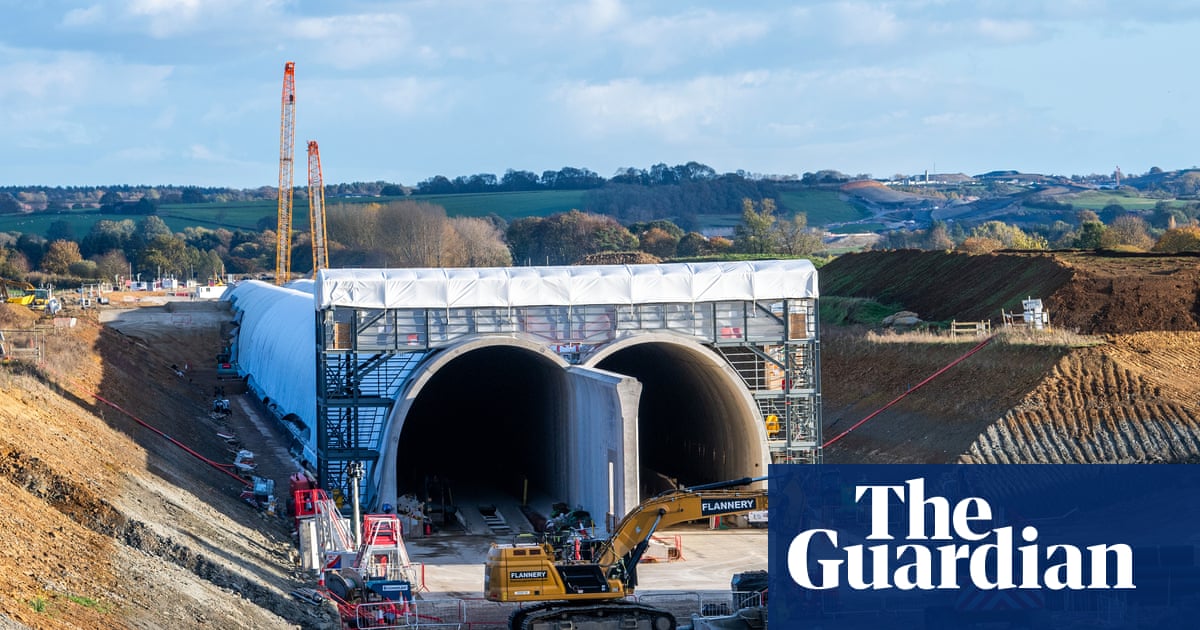
Ten years ago, I walked the route of HS2, the 140-mile railway proposed to run from London to Birmingham, to discover what lay in its path. Nothing had actually been constructed of this, supposedly the first phase of a high-speed line going north. The only trace was the furtive ecological consultants mapping newts and bats and the train’s looming presence in the minds of those who lived along the route. For many, it was a Westminster vanity project, symbolising a country run against the interests of the many to line the pockets of the few. People whose homes were under threat of demolition were petitioning parliament, campaigning for more tunnels or hoping the project would collapse before their farms, paddocks and ancient woodlands were wiped out.
The line, we were told a decade ago, would be completed by 2026. Like many of the early claims about the longest railway to be built in Britain since the Victorian era, that fact no longer stands. The fast train is running – very – late. The official finish date of 2033 was recently revised upwards. “The best guess is that it will begin with a ‘4’ when you can catch a train,” one well-informed observer told me. There’s similar uncertainty about its cost, but one thing is sure: it is catastrophically over budget. When complete, HS2 will almost certainly be the most expensive railway in the world. Nearly 20 years ago, HS1, the line from the Channel tunnel to St Pancras, was completed on time and on budget for £51m per mile (£87m in today’s prices). It was criticised for being twice as expensive as a high-speed route constructed in France. HS2 may cost almost £1bn per mile.
In 2020, construction formally began at last. The line is being built by HS2 Ltd, a government-owned company funded entirely by taxpayers’ money. A decade after my first walk, I retraced my steps beside the line. I wanted to find out what had changed for the landscape and its inhabitants, and see if this reshaping of middle England was better than people had expected, or even worse.
Day one: West Ruislip to the Colne valley, six miles
Since the line begins with 13 miles of tunnel from Euston, I started my walk where trains will emerge, beside West Ruislip tube station on the western edge of London. Over the next eight days of walking, I discovered that HS2 is the most beneficent railway in the world. What other company would lay on a minibus so schoolchildren can get to their summer jobs? Scatter rock-salt on cycle tracks so cyclists don’t slip over in winter? Buy a Christmas tree every year for a village bisected by the line? Build holts for otters? Add top-class catering facilities to a village hall that even the villagers didn’t ask for?
And yet some of those directly affected by the line, whose homes have been blighted or farms sliced in half, tell of the meanness of HS2 Ltd. Its negotiators are said to refuse to pay market rates for properties, or haven’t promptly or fully compensated small businesses. (HS2 said it aimed to offer “fair and timely compensation” for property, while considering cost to the taxpayer.) Just as HS2 cuts through the middle of England, so it may be a gauge of English politics and business today: democratic and remote, profligate and parsimonious, controlling and inefficient.
I followed the first of many “footpath diversion” signs out of West Ruislip, weaving through the now-derelict golf course borrowed by HS2 for various works. (The company has bought some land but taken “temporary possession” of much more. In HS2-world, temporary is a long time.) Clank-clank-clank. Jugga-jugga-jugga. Beep-beep-beep. The people living beside HS2 have endured more than half a decade of construction work.
Building a railway is not easy, especially somewhere as densely populated as England. Building a high-speed railway is even harder, because the route must be as straight as possible. Complex engineering solutions are needed to navigate the intricate lacework of southern England, its roads, rivers, railways, tracks, footpaths, woodlands and wetlands. After tortuous parliamentary approval, “enabling works” were permitted to remove trees and hedgerows and reroute roads and utilities. So many roads are being rerouted that one engineer described HS2 as “a road project with a train in the middle of it”.
Open gallery | 0
The line includes 52 major viaducts and five tunnels, totalling more than 40 miles. These expensive feats of civil engineering are being undertaken by four consortiums, combining British building giants with European comp
Continue Reading on The Guardian
This preview shows approximately 15% of the article. Read the full story on the publisher's website to support quality journalism.