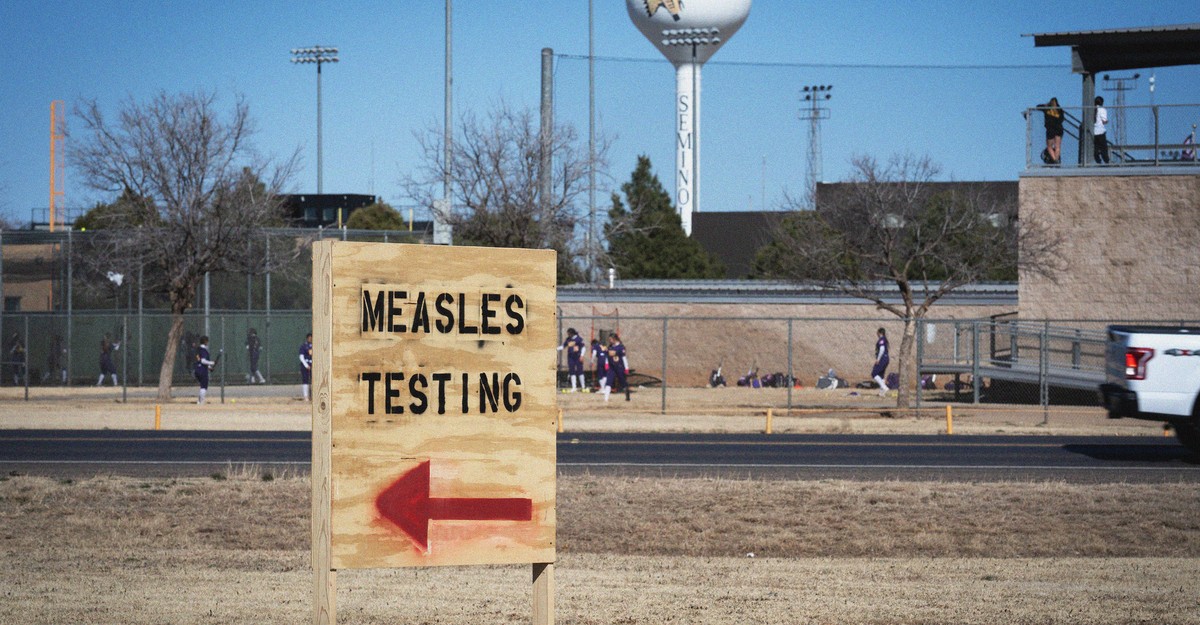
In the early 1960s, American childhood was not what it is today. Many children spent hours playing unsupervised in the streets; they rode around in cars without seat belts, then came home to frozen dinners, served in front of TVs blaring cigarette ads. And at some point, they’d almost certainly get measles.
The illness—caused by a virus that is estimated to infect roughly 90 percent of the unimmunized people it comes into contact with—is widely considered one of the fastest-spreading diseases to ever plague humankind. Before the debut of the first measles vaccine, virtually every child in the country could expect to contract it by the time they finished middle school, making it an experience nearly as universal as entering a classroom, skinning a knee, or enduring puberty. “It was sort of a rite of passage,” Kathryn Edwards, a pediatrician and vaccine expert who retired from Vanderbilt University Medical Center in 2022, told me. Edwards, 77, is one of many people born before the first measles vaccine was licensed in 1963; she can vividly recall the pain, discomfort, and fear of having the disease.
The rise of measles vaccination changed all that, and by 2000, the disease had been declared eliminated from the United States, after public-health officials detected no transmission of the virus for a full year.
Continue Reading on The Atlantic
This preview shows approximately 15% of the article. Read the full story on the publisher's website to support quality journalism.