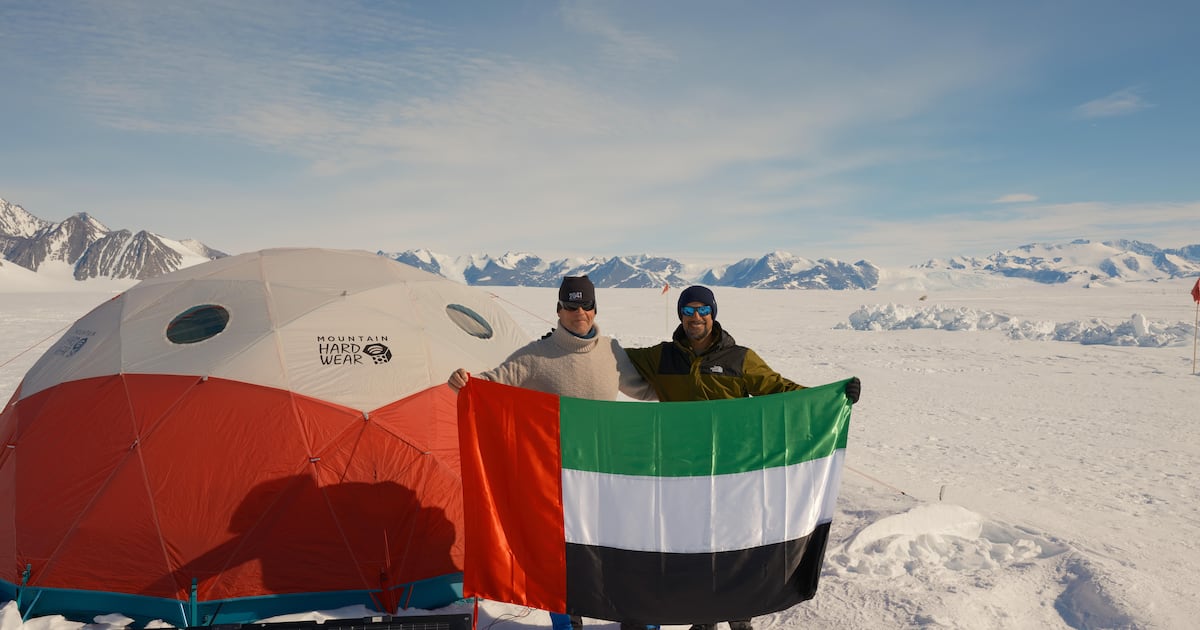
The UAE is rapidly establishing itself as a leader in the global space race - but it is also making significant strides in a mission to explore some of the harshest environments on Earth.
Central to this quest is the Emirates Polar Programme, which puts Emirati scientists at the forefront of international research in Antarctica and the Arctic.
As President Sheikh Mohamed said at the programme's launch in 2023, the polar regions are sentinels of climate change, biodiversity and human resilience.
The need to protect them has never been more critical. They are experiencing the most rapid rates of warming on the planet, with far-reaching consequences for natural ecosystems and human activity worldwide.
'Third Pole'
The Arctic is not a continent, but a frozen ocean capped by ice that expands and contracts with the seasons and is bordered by eight sovereign countries.
Antarctica, by contrast, is. Much of it sits more than 500m above sea level, making it the coldest and highest continent on the planet, where temperatures can fall below minus 60°C in winter.
Antarctica has no permanent human population and supports only the most minimal forms of terrestrial life. Yet it holds nearly 70 per cent of the world’s freshwater, preserved in ice built up over millions of years.
As global temperatures rise, changes in this ice are already reshaping oceans and coastlines far beyond the poles.
“The polar regions are the planet’s thermostat, that’s why they matter,” Wassim Said of the Emirates Polar Programme Steering Committee told The National. “They are geographically distant, but they are very close from an impact perspective.”
However, the UAE’s polar thinking does not stop at the Arctic and Antarctica.
Gentoo penguins walk at Neko Harbour in Antarctica. AP Photo
“There is also what scientists call the ‘Third Pole’,” said Dr Said, referring to the extensive glaciers and permanent ice across the Hindu Kush-Himalayan region.
“It’s not a single geographic point, but a scientific term used to describe the largest mass of ice on Earth outside the two polar regions.”
Repair the world we have
Stretching across several countries, the region feeds major river systems and supports the livelihoods of hundreds of millions of people. While only about four million people live north of the Arctic Circle, more than 250 million live in proximity to the Hindu Kush–Himalayan region.
“When ice cycles destabilise there,” said Dr Said, “you can see devastating flash floods followed by severe droughts. What happens in those mountains affects food systems, migration and stability across entire regions.”
The thinking behind the UAE’s polar engagement began forming in 2022, during a period of int
Continue Reading on The National UAE
This preview shows approximately 15% of the article. Read the full story on the publisher's website to support quality journalism.