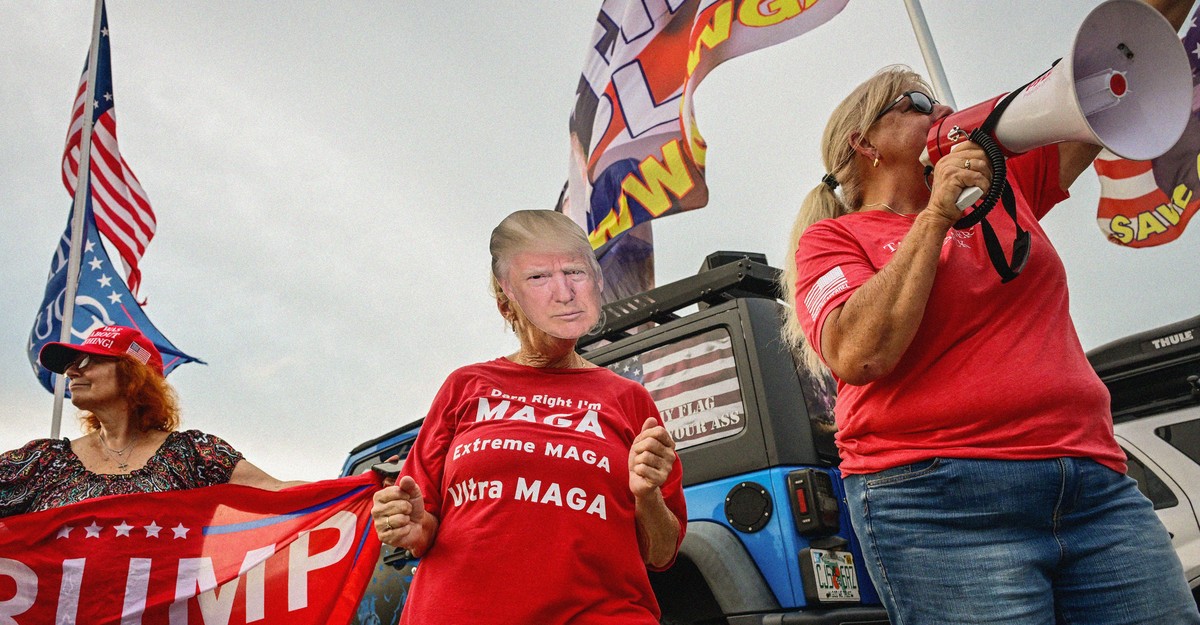
To judge by recent accounts, Donald Trump’s intervention in Venezuela has imperiled his standing among his own supporters. Traditional-media outlets have warned of a MAGA schism, as have some high-profile right-wing influencers. “President Trump seized control of the Republican Party on an anti-interventionist ‘America First’ platform,” The New York Times reported on January 4, but his removal of Venezuela’s leader “threatened to open a new rift within the political movement he has built.” The former Trump strategist Steve Bannon told the paper that the president’s messaging “on a potential occupation has the base bewildered, if not angry.” Two months before the U.S. military captured Nicolás Maduro, the conservative commentator Tucker Carlson warned against American intervention and suggested that efforts to oust the Venezuelan dictator were part of—I am not making this up—a “globohomo” conspiracy to bring gay marriage to the country.
The theory of a MAGA rupture over Venezuela has a certain surface plausibility. It’s also completely contradicted by what masses of Trump’s backers are telling pollsters. Two days after the Maduro operation, a Reuters/Ipsos poll found that 65 percent of Republicans supported it, compared with just 6 percent who didn’t. Another poll, by The Washington Post, pegged that support at 74 percent. And a subsequent YouGov/CBS survey recorded even more striking results: 89 percent of Republicans backed Maduro’s ouster, and for self-described “MAGA Republicans,” the number was 97 percent—a level of enthusiasm that would ma
Continue Reading on The Atlantic
This preview shows approximately 15% of the article. Read the full story on the publisher's website to support quality journalism.