By Zhao Ruinan in Nanchang,Zhou Huiying in Harbin and Yan Dongjie in Tianjin | China Daily | Updated: 2026-01-26 09:05
Editor's note: As protection of the planet's flora, fauna and resources becomes increasingly important, China Daily is publishing a series of stories to illustrate the country's commitment to safeguarding the natural world.
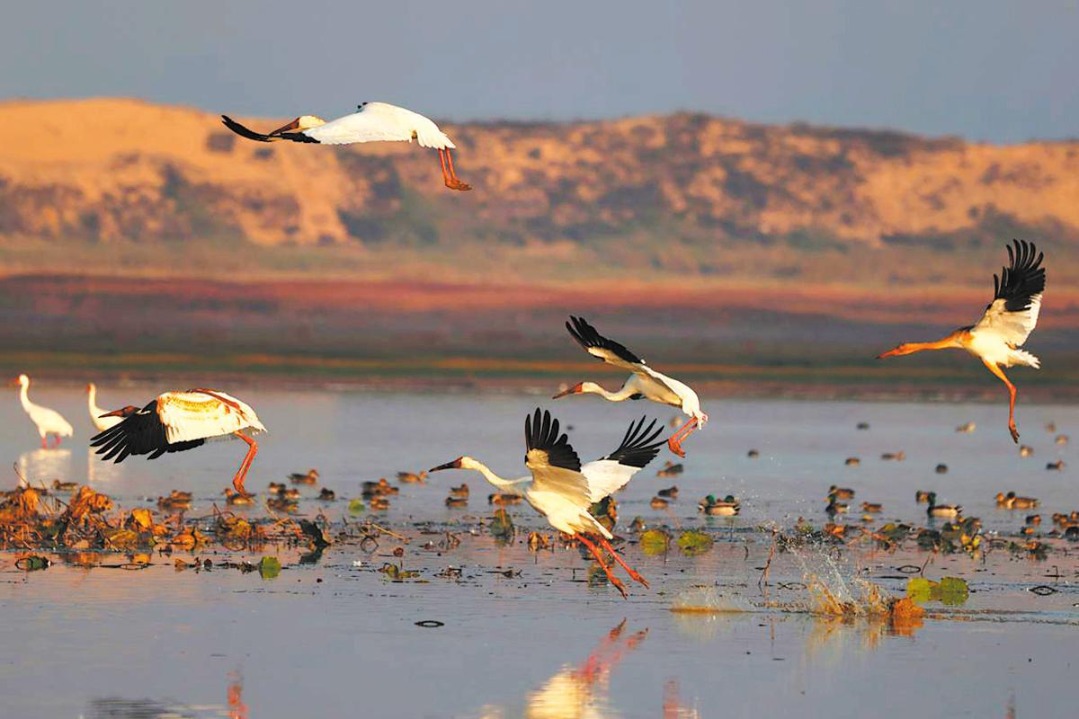
Restored wetlands welcome new flocks of migratory birds. [Photo provided to CHINA DAILY]
On a viewing platform at Poyang Lake, a group of students gathers around their teacher, pointing toward the shallows as waves of birds lift and settle. The scene — too swift for phone cameras to capture — is the biological evidence of a massive, systematic overhaul of China's wetland management.
"It's hard to tell where to look first," said one student. The group, traveling from Wuhan, Hubei province, had gathered to learn about the ecological development of Jiangxi province. Their teacher, Zhang Jingyi, gestured toward white cranes. "They take turns — a bit like traffic," he said.
This "traffic" follows the East Asian-Australasian Flyway, a 5,000-kilometer migration corridor where Poyang Lake, China's largest freshwater lake, serves as the critical wintering terminus.
According to official monitoring data, the lake hosts nearly 400 bird species and around 700,000 birds during the wintering season, including more than 90 percent
Continue Reading on China Daily
This preview shows approximately 15% of the article. Read the full story on the publisher's website to support quality journalism.