Nearly as old as Ahab (one more birthday and I’ll be 58: his age), I drive south from Boston on a recent Saturday morning. Through a raging drabness of Massachusetts wintertime, I drive and drive: leaky light without a source; seething, decaying snow.
I’m on a mission here. A collision with immensity awaits: the 2026 Moby-Dick Marathon at the New Bedford Whaling Museum. Programming, scholarship, and—the event’s steadily droning core—a 25-hour cover-to-cover reading of the great book itself. Hundreds of volunteer readers, in five-minute increments, from noon on Saturday to 1 p.m. on Sunday. A test of my fortitude as a listener, of my ability to keep my behind in a seat.
But I am faint. Succor is required. I pull over at the Bridgewater Service Plaza because sometimes what you need is to quietly conform yourself to the will of God, and sometimes what you need is a cup of stinking black coffee and a Dunkin’ glazed doughnut.
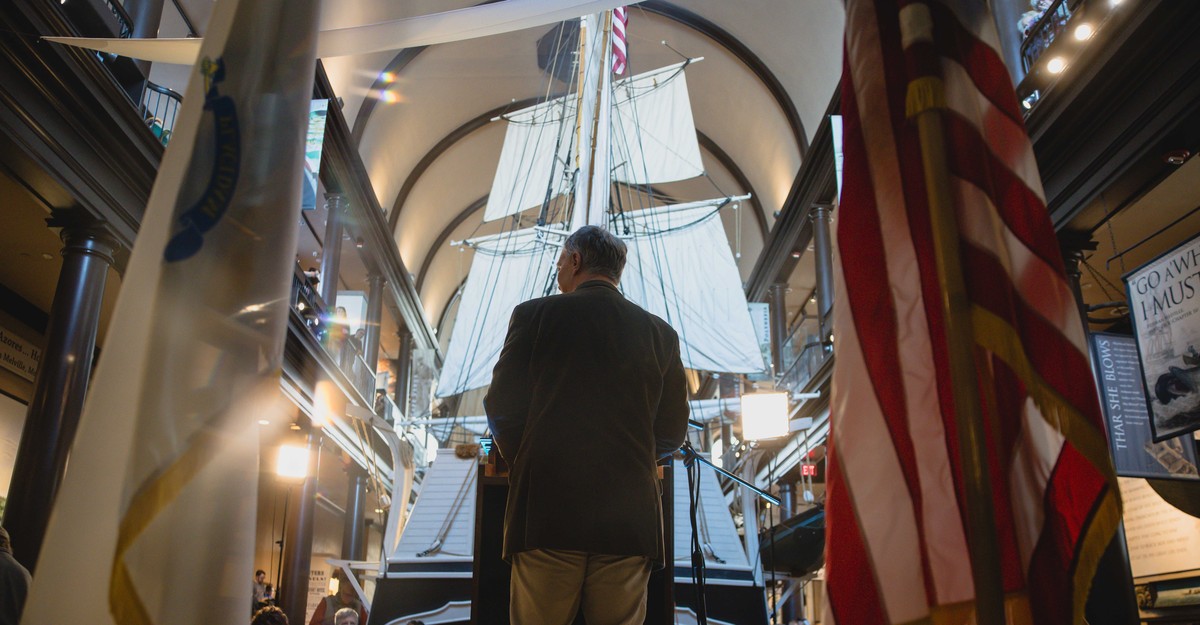
Into snowy New Bedford, into the Whaling Museum, into the room where they keep the Lagoda, the museum’s half-scale model of a whaling bark. A room with a ship in it, in other words. Two stories high (to accommodate the ship’s masts) and stuffed, draped, festooned with humanity: sitters, knitters, nesters, kneelers, sprawlers, leaners, drifters like me, stashed in every alcove and stretched along every railing and baseboard. At noon on the nose, the Massachusetts poet laureate, Regie Gibson, steps up to the lectern: “Call me … Ishmael.” The whoop, the sound of exulting Moby-Dick nuts, goes raggedly around the galleries and hallways of the museum.
Continue Reading on The Atlantic
This preview shows approximately 15% of the article. Read the full story on the publisher's website to support quality journalism.