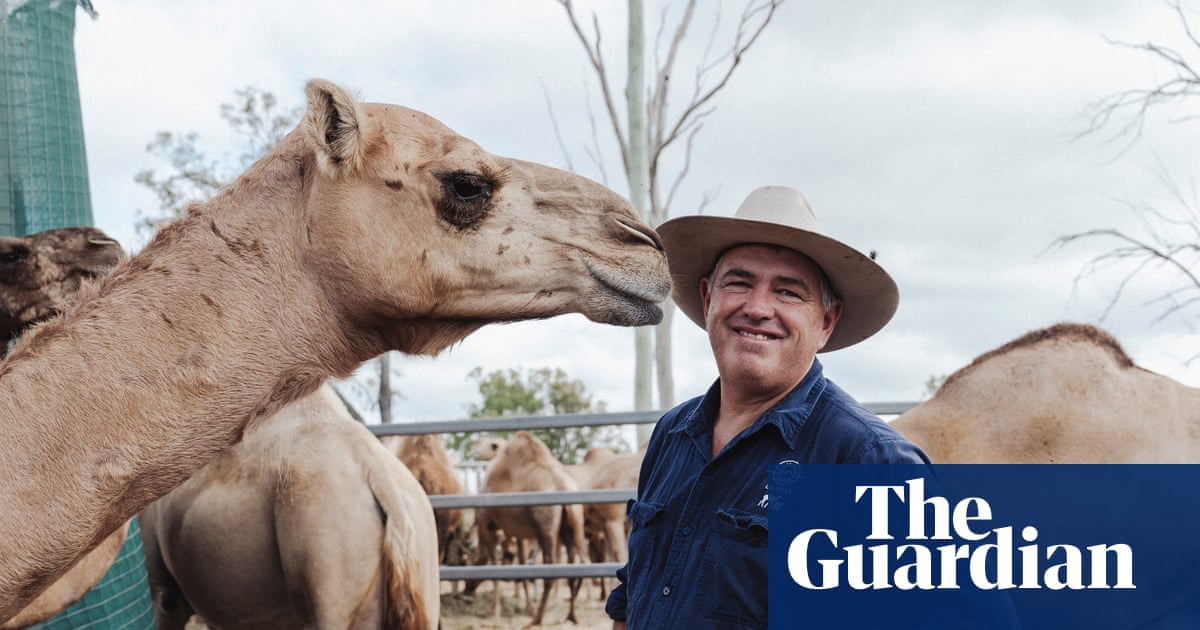
Caroline’s sultry and soulful eyes are hooded and heavy-lashed.
“She’s straight out of central,” Paul Martin whispers, gazing at his star performer with admiration.
Martin is not speaking of central casting – the camel farmer is referring to the Central Desert region of Australia, where at least half a million of Caroline’s kin roam wild.
Now far from feral, Caroline quietly chews cud as suction cups on her teats gurgle away, hoses connected to 8-litre glass bottles filling up with pure white milk.
Behind Caroline is Mildred, the second in a line of 10 in this open-air dairy shed, an hour’s drive from the metropolis of Brisbane and thousands of kilometres from Australia’s arid heart. Instead of red dunes and vast spinifex plains, these camels are surrounded by lush pasture and a horizon of jagged and wooded peaks.
View image in fullscreen Unlike cows, camels can ‘hold their milk’– meaning farmers like Martin have to coax, not coerce them into their new roles in the dairy. Photograph: Jamila Filippone/The Guardian
After a decade of supplying the domestic camel milk market from this 130 hectare (320 acre) farm in south-east Queensland’s Scenic Rim – one of the first commercial camel dairies in Australia – Martin wants to start supplying the stuff to the United States.
Continue Reading on The Guardian
This preview shows approximately 15% of the article. Read the full story on the publisher's website to support quality journalism.