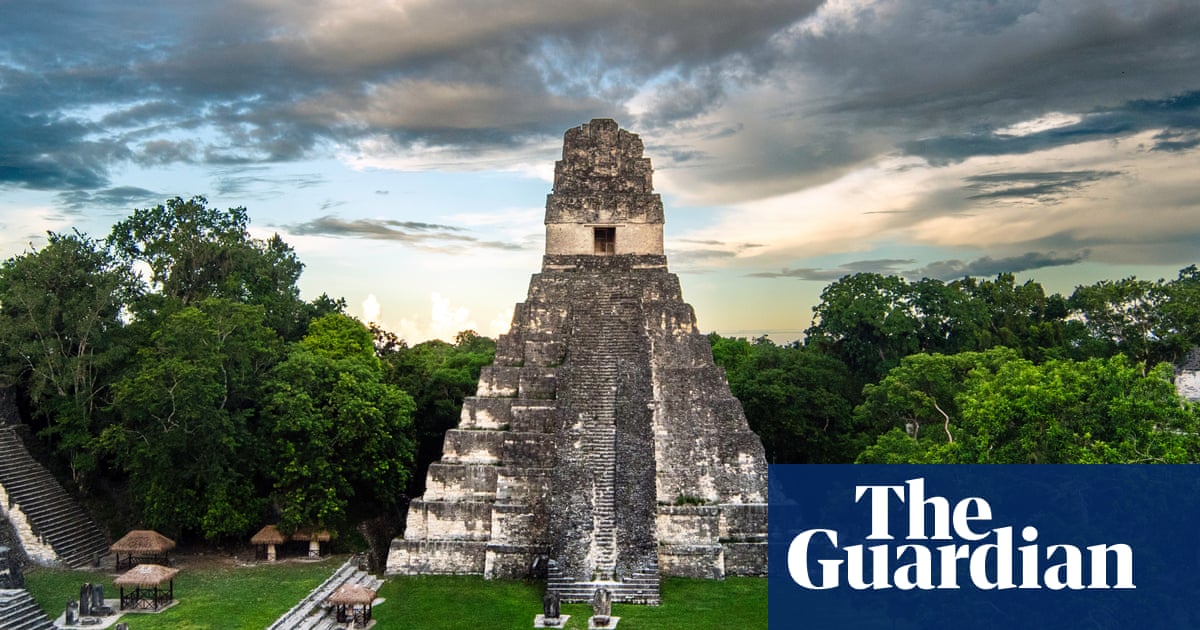
As a seven-year-old, Francisco Estrada-Belli was afraid all of history would have been discovered by the time he was old enough to contribute. The year was 1970 and he and his parents had come from Rome to visit relatives in the Central American country of Guatemala. On the trip, they visited the ancient Maya ruins at Tikal. “I was completely mesmerised,” Estrada-Belli told me recently. “It was jungle everywhere, there were animals, and then these enormous, majestic temples. I asked questions but felt the answers were not good enough. I decided there and then that I wanted to be answering them.”
Fifty-five years later, Estrada-Belli is now one of the archaeologists helping to rewrite the history of the Maya peoples who built Tikal. Thanks to technological advances, we are entering a new age of discovery in the field of ancient history. Improved DNA analysis, advances in plant and climate science, soil and isotope chemistry, linguistics and other techniques such as a laser mapping technology called Lidar, are overturning long-held beliefs. Nowhere is this more true than when it comes to Maya archaeology.
Last year, Estrada-Belli’s team, including his Tulane University colleague Marcello A Canuto, published a study with a central finding that would have seemed, just a few years ago, like an outrageously speculative overestimate. When Estrada-Belli first came to Tikal as a child, the best estimate for the classic-era (AD600-900) population of the surrounding Maya lowlands – encompassing present day southern Mexico, Belize and northern Guatemala – would have been about 2 million people. Today, his team believes that the region was home to up to 16 million. That is more than five times the area’s current population. This would mean that more people lived in the classic-era Maya lowlands than on the Italian peninsula during the peak of the Roman empire – all crammed into an area a third of the size.
A comparison between the classic Maya and ancient Rome is instructive in other ways. Some Maya cities were established hundreds of years before the founding of Rome, and they included significantly larger architecture that still stands. Both cultures developed sophisticated astronomy, mathematics, writing and agriculture, as well as elaborate trade arrangements across vast cosmopolitan lands. The ruins of Rome are today covered by a bustling world city where some of the most prominent elite families claim to trace their ancestry directly to ancient times. Many Maya ruins, in contrast, are now covered by more than 1,000 years’ worth of tropical forest while the descendants of the peoples who built those cities are some of the poorest people on Earth.
According to census records, the various Maya and much smaller Indigenous groups, such as Xinka and Garifuna, today account for more than 11 million people across Mexico, Guatemala, Belize, El Salvador, Honduras and the US. Most of them, 7.7 million, live in Guatemala, where they officially comprise 44% of the population. (Human rights organisations believe the number may be higher as it has long been stigmatised, even dangerous, to identify as Maya.)
History – both ancient and recent – is a key political issue for the Maya. In Guatemala, they have two central demands: first, that there be a full reckoning with the civil war and genocide that lasted from 1960 to 1996, and claimed about 200,000 lives, most of them Maya. Second, that they are recognised as the original inhabitants and legitimate owners of this land. As they see it, half a millennium of prejudice and discrimination against their community has led to a situation where, among other issues, two-thirds of the country’s arable land is controlled by only 2.5% of its farmers, few of them Maya, while 60% of Indigenous children are undernourished.
In 2023, the Maya peoples played a key role in the unlikely presidential election victory of a former diplomat named Bernardo Arévalo. The campaign to protect the vote against a corrupt judiciary was led by Indigenous groups and included 106 days of nationwide protests. Although Arévalo is not himself Maya, he is sympathetic to their cause. One of the people he appointed to his government is Liwy Grazioso, another prominent archaeologist with Italian roots, who now serves as minister of culture and sports.
Continue Reading on The Guardian
This preview shows approximately 15% of the article. Read the full story on the publisher's website to support quality journalism.