“There is no escape from it. It’s as simple as that.”
Commodore Anil Jai Singh is not describing a disaster. He is recounting a normal day inside one of the most hostile and extreme places on Earth, a submarine.
Singh served the Indian Navy for 30 years, from 1981 to 2011, and commanded four submarines, from 1994 to 1998. He is now 66, Vice President of the Indian Maritime Foundation, and entirely composed while explaining the engineering of submarines.
Read Full Story
What does not leave him composed is a different question entirely. Not what happens when the engineering fails. What happens when it works perfectly?
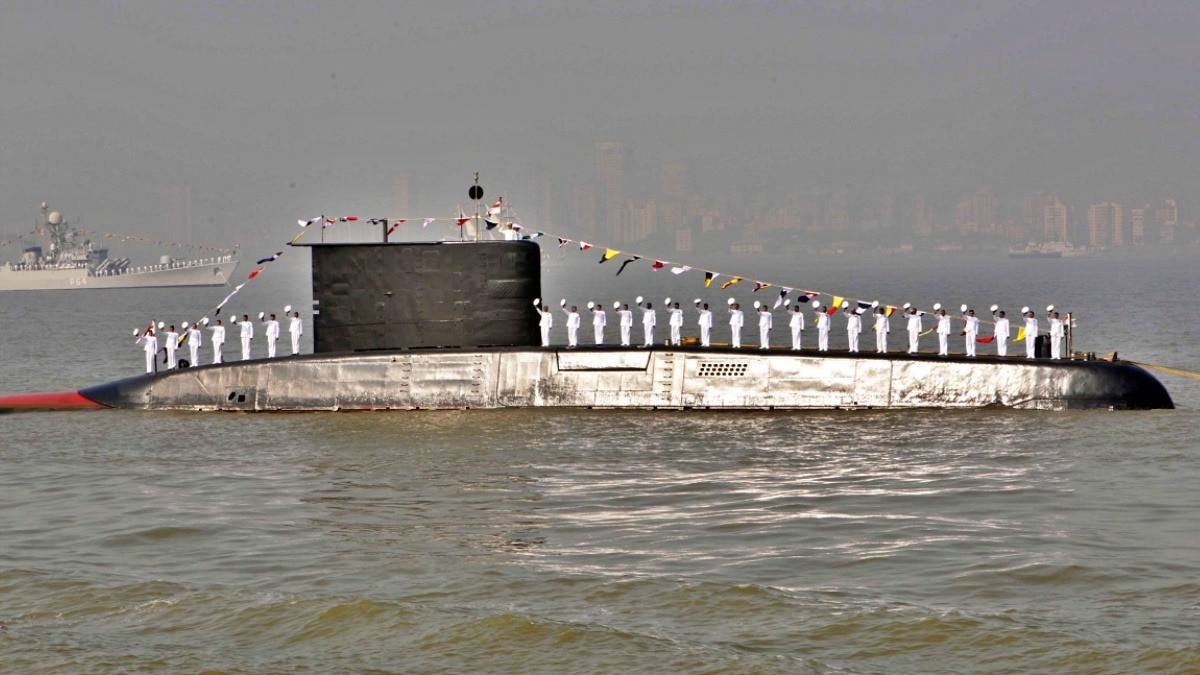
When the submarine functions exactly as designed, when the crew survives every dive, when a man spends months inside a sealed steel cylinder breathing chemically manufactured air, sleeping in inverted cycles, absorbing constant low-frequency vibration through his bunk, and running stress hormones at levels that would alarm any physician who examined him without knowing his occupation, what does that environment do to the human body over the course of a career? Indian submarine 'INS Shalki' (C) leaves port during the joint Indo-US naval exercise off the Goa coast. (Photo: Getty)
“What the long-term health effects of living inside a submarine will be is something any submariner would want to know ultimately,” he tells indiatoday.in. “We have no idea yet.”
India has operated submarines for 58 years, since December 1967. The answer to that question has not arrived.
THE FIRST TEST IS NOT MEDICAL
Before a submarine can do anything to a person, the person must first prove they can survive inside it. This process does not begin with a blood test. It begins at a tank of water in Visakhapatnam.
Surgeon Commander Dr Tarun Sahni (Retd) served 18 years as a submarine medical officer in the Indian Navy, sailed on submarines himself for stretches of up to 15 days, and now heads the Department of Hyperbaric Medicine at Indraprastha Apollo Hospital, New Delhi.
Before answering any clinical question about submarine physiology, he insists on explaining the selection mechanism first. Without understanding it, he argues, nothing about submarine health data makes sense. A submariner trains in an escape drill tank (left); the submarine escape suit used (centre); a crew member exits through the escape hatch during a drill (right). (Photo: Special arrangement)
At the submarine training base in Visakhapatnam, every candidate, regardless of rank or professional qualification, must complete the escape training tower drill.
They are sealed into a water suit and asked to crawl through a torpedo tube roughly 30 to 40 feet long. The tube is filled with water. At the other end, they are released into a pool and must free-ascend 20 to 30 feet to the surface, manage the pressure change in their lungs, and control their breathing, all without panicking.
“If you do not qualify the escape training tower drill, you are disqualified from the course, and you are asked to leave,” Commander Sahni tells indiatoday.in. “This is irrespective of rank and qualification. You could be a navigator, you could be a doctor, you could be a paramedic. But if you do not qualify the psychological screening of the escape training tower drill, you can never become a submariner.” A young Dr Tarun Sahni (left, in army uniform) pictured alongside a fellow officer aboard INS Vaghsheer (S43), shortly before he transferred to the Navy and joined the submarine service; Dr Sahni in a full escape suit during a crew escape drill (right). (Photo: Special arrangement/Surgeon Commander Dr Tarun Sahni (Retd))
advertisement
This is the first and most important act of submarine medicine. Not treatment, not monitoring. Elimination. The environment does not accommodate the full range of human physiological and psychological responses to confined, high-pressure spaces.
The escape tower removes anyone who cannot suppress the instinct to panic before they have spent a single day at sea. What remains is a population filtered to the extreme end of the psychological distribution.
When Commander Sahni later dismisses the most alarming hypotheses about submarine heal
Continue Reading on India Today
This preview shows approximately 15% of the article. Read the full story on the publisher's website to support quality journalism.